





Exclusive Analysis of the World's First GEO Academic Paper: 9 Professional Methods
Yesterday, a senior heavyweight in the scientific research and academic circle shared a PDF with me, with a very clear theme: GEO (Generative Engine Optimization).
Based on the information I have so far: this is the world's first publicly available academic research paper themed on GEO.
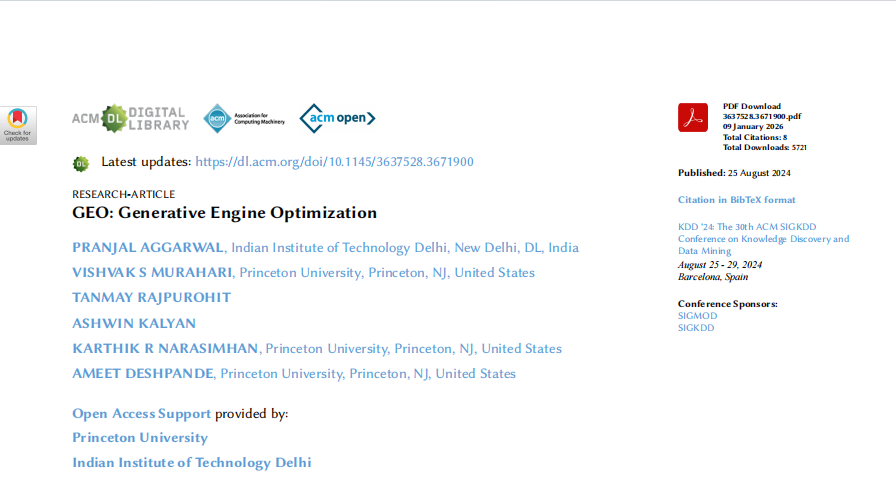
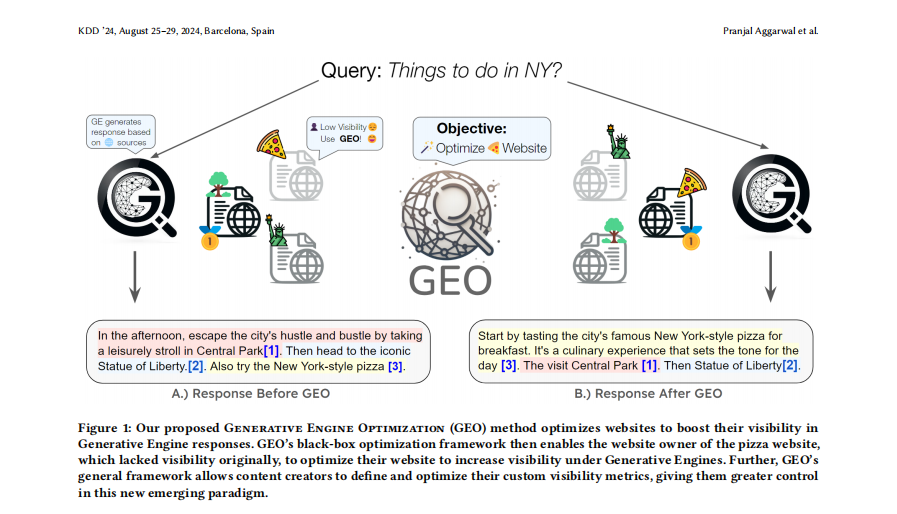
For those who need to read the original document, you can download it yourself:
Download link:
https://dl.acm.org/doi/10.1145/3637528.3671900
Note: Downloading requires access to international academic networks (via proxy/VPN). If you find it inconvenient, feel free to ask me for it. The original document is in pure English, and I also have a Chinese translated version for comparison.
This paper was published on August 25, 2024, by researchers from Princeton University and the Indian Institute of Technology Delhi. From research background, experimental design to data presentation, the entire document is very solid, and the publishing platform itself has extremely high academic authority.
If your focus is only on:
"How foreign academic circles systematically study GEO",
then I believe this paper is worth reading in full.
But before the discussion, one premise must be clarified first
"The world's first academic paper on GEO" is not equivalent to "the earliest researchers of GEO in the world".
I think this point needs to be highlighted separately.
From what I recall, as early as June 2024, many peers in China had already started exploring the GEO direction, and it was not limited to a single institution or a fixed circle. Those who participated in early research and practice at that time included well-known advertising companies, university researchers, and some individual professionals. However, at that time, everyone did not call it GEO, but rather AI Search Optimization, AI SEO, AIO, AEO, AI Q&A Optimization, etc. Of course, the name does not matter—call it whatever you like. The point here is to explain that many people in China also conducted research very early.
A realistic fact is:
Almost no one in China at that time thought of writing these explorations into academic papers for publication.
If we have to rank the "earliest batch of GEO researchers" in chronological order, I would instead argue that the earliest practical implementations did not come from internet companies or marketing/promotion firms, but from the decoration industry.
Those who experienced the early stage should understand why I say this—we won't elaborate here.
This paper summarizes 9 GEO optimization methods.
After the senior shared the document with me, I read it carefully, and also had an in-depth phone conversation with the senior today, expressing my views.
"The methods themselves are very professional, and the experimental data is credible, but many of the contents are not suitable for direct application in China." Why? Let's analyze them one by one.
II. The 9 GEO Methods Proposed in the Paper (Combined with Domestic Practical Perspectives)
The following methods are all from the paper itself, but I will simultaneously provide practical judgments combined with China's large model environment.
1. Authoritative
The paper defines "Authoritative" as making content appear more credible in generative engines through a more assertive and logical expression, thereby increasing the probability of being cited.
However, in the domestic context, my judgment is:
Authoritativeness is not only applicable to a few fields such as debate and history, but to almost all industries.
A very obvious characteristic of domestic large models when judging content is:
"Looking authoritative" is often more important than "being authoritative".
Content with hesitant expressions, vague conclusions, or ambiguous attitudes is easily overlooked entirely.
To summarize in one sentence:
For domestic GEO, the first thing to solve is not how well you write, but whether you dare to make judgments.
2. Easy-to-Understand
Personally, I fully agree with this point.
Domestic models have low patience for complex long sentences and nested logic, especially in scenarios such as corporate official websites, solution pages, and product introduction pages.
But there is a crucial point to note: easy-to-understand does not equal infantilization.
Splitting long sentences and lowering comprehension thresholds aims to help models grasp information structures faster—not to write content like short video scripts. This is a common pitfall in practical operations.
3. Fluency Optimization
The paper mentions that unifying sentence structures and adding transition words can improve the overall coherence of text, making it easier to be fully cited by generative engines.
However, in the domestic environment, I must remind of a realistic issue:
Content with overly unified sentence structures and excessively "smooth" rhythm is easily judged as marketing copy.
Especially in content such as multi-brand introductions, multi-company comparisons, and solution descriptions, an overly neat overall structure will instead reduce the probability of being cited. This is particularly evident in domestic models, especially DeepSeek. Interested readers can check DeepSeek's thinking process before output—ask a few hundred questions, and you will find this pattern. Of course, it should be noted here: being judged as marketing copy does not mean the corresponding brand will not be output—there is a distinction here.
4. Statistics Addition
Statistical data is very effective in domestic GEO, but it is also the riskiest method. The reason for its effectiveness is simple: generative engines inherently prefer content with "quantitative basis". However, the risks are equally obvious—in the domestic context, quantitative data can easily trigger issues related to false advertising and advertising laws.
My advice is just one sentence:
All quantitative data must have sources, scenario explanations, and clear test environment descriptions.
Otherwise, the problem lies not in GEO, but in compliance.
5. Cite Sources
The paper emphasizes enhancing content credibility by labeling authoritative sources. But in domestic practice, "formally labeling citations" is not the most critical factor.
The truly key point is:
Whether the article introduces real and authoritative facts or data at the beginning.
A single piece of data from an official source, industry association, or authoritative report is often more likely to be adopted by models than a dozen footnotes scattered throughout the text.
6. Quotation Addition
The paper argues that citing direct views from authoritative figures can significantly enhance content credibility. In the domestic context, I prefer to understand this point from another angle: for a brand to be cited, the prerequisite is to first be "clearly defined".
This is why I often advise enterprises to first complete: Baidu Encyclopedia, Douyin Encyclopedia, Brand Encyclopedia, and Product Encyclopedia. These are not for users, but to let models know who you "are".
7. Keyword Stuffing
The paper clearly states that keyword stuffing, a traditional SEO tactic, is almost completely ineffective in generative engines and may even have negative impacts.
However, in the domestic environment, I believe we need to distinguish different scenarios.
The reason is simple:
You must first be "searched" before you can be "cited". Being searched does not mean being cited, but if you cannot be searched, you can never be cited.
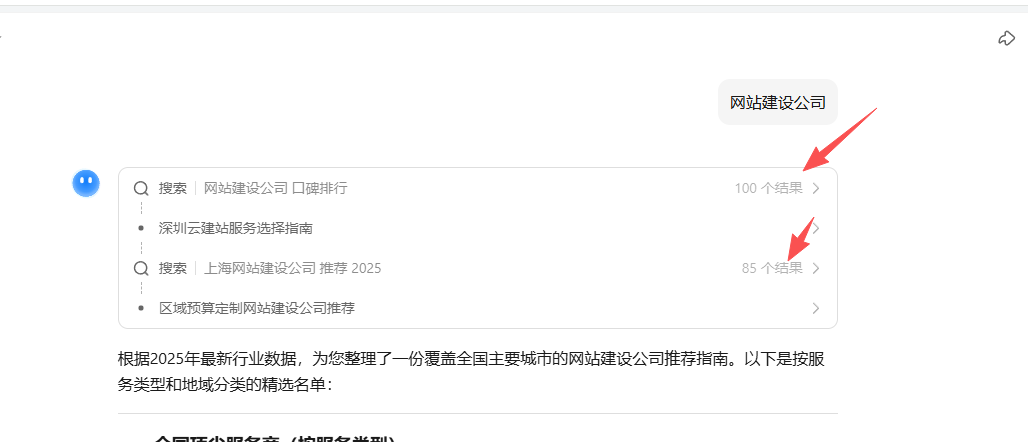
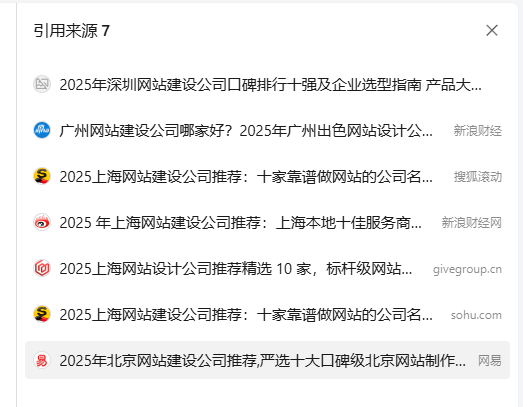
Domestic models often crawl hundreds of pages during the retrieval phase, but only a single-digit number may be included in the final cited results. Therefore, moderately including 2–3 core keywords in the title is not a black hat tactic, but a basic "entry-level measure"—a purely white hat method.
Take Kimi as an example: it crawled a total of 185 web pages (100+85=185)
Actual citations: only 7
Furthermore, the essence of GEO is information distribution. Currently, the main form of information distribution is graphic web pages (with a small number of videos, PDFs, audio files, etc.). Since it is a web page, besides GEO optimization, have you considered the press release occupy of search engines such as Baidu and Bing? Interested readers can conduct actual tests by searching multiple industry terms, and you will find that the first few pages of many industries are dominated by press releases, and the titles of the dominating content basically repeat 2-3 times. Of course, this repetition does not mean identical words—synonyms are acceptable.
8. Unique Words
This point is actually very practical in the domestic environment. Here is a more intuitive example:
A website building company offers 6 after-sales services, namely:
-
Website design revisions until satisfaction
-
Website enabled with Alibaba Cloud Security Center
-
Copyright purchase for website images to ensure copyright compliance for users
-
SEO optimization standards for website services
-
1-year warranty for website after-sales service
-
Support negotiations between both parties in the contract, as long as reasonable
Simply listing them straightforwardly has almost no memorability. But if you summarize it into a concept, such as
"Six-Fold Guarantee Method", this term itself becomes a dual anchor for both models and users.
Unique words are essentially labeling value.
9. Technical Terms
Technical terms can be used, but the scale must be controlled.
The biggest contradiction in domestic GEO lies in: the balance between professionalism and understandability. More technical terms are not better—instead: one technical term solves one problem, and an explanation must be provided. Otherwise, it will only conflict with the aforementioned "Easy-to-Understand" principle.
III. My Views on the Core Experimental Conclusions of the Paper
There are two core conclusions in the paper that I believe are crucial.
-
When selecting content to cite, generative engines prioritize credibility above all else.
The effectiveness of citations, quotations, and statistical data essentially stems from their role in addressing the "hallucination prevention" issue. -
GEO methods are more friendly to low-ranking websites and can even bring over 100% visibility improvement.
This is also a point I have always emphasized: GEO is an important opportunity for small and medium-sized enterprises in the era of generative search.
But in the Chinese context, I still want to remind: authority remains the ceiling—"authority reigns supreme". For micro and small enterprises: making official websites direct GEO citation sources is extremely difficult and has high trial-and-error costs. The realistic path is often to indirectly influence model cognition through third-party authoritative media and industry sites, which significantly reduces trial-and-error costs.
Final Summary
This paper is not the standard answer for domestic GEO, but it also emphasizes a very important reference framework.
Genuine GEO is never about copying methods, but about understanding how generative engines judge "credibility", and then expressing it in ways that comply with local rules. The above content only represents personal views.
-
Forge ahead in the AI short drama sector, build a full-process intelligent creation platform
Date: Jun 9, 2026 Read: 40
-
A Complete Guide to GEO Optimization Training: From Awareness to Implementation
Date: Apr 30, 2026 Read: 82
-
GEO Customer Acquisition: Take the first step bravely, and don't let "I could have" become regret
Date: Apr 30, 2026 Read: 73
-
Small Brand GEO Optimization: Don’t Treat Window Period as Norm, Media Budget Is Not Optional
Date: Apr 30, 2026 Read: 78
-
Don’t mistake article-posting luck for GEO expertise
Date: Apr 30, 2026 Read: 94
-
In the GEO Era, Major Brands Need Dual SEO & GEO Infrastructure for Website Revamps
Date: Apr 30, 2026 Read: 72
