





AI Ordered My Takeout—GEO Is No Longer Marketing, But a Survival Line.
On January 15th, news that the Qianwen App was integrated with Alibaba's ecosystem went viral. Ordering takeaways, shopping, booking flights—tasks that once required us to open multiple Apps to compare prices and filter options manually can now be done simply by telling AI what we want with our voice.
To be honest, I saw this news pop up that night, but I was swamped with an SEO diagnostic report for a major client and only found time to test it out this afternoon.
Writing the report gave me a massive headache, so I simply used Qianwen to order a takeaway.
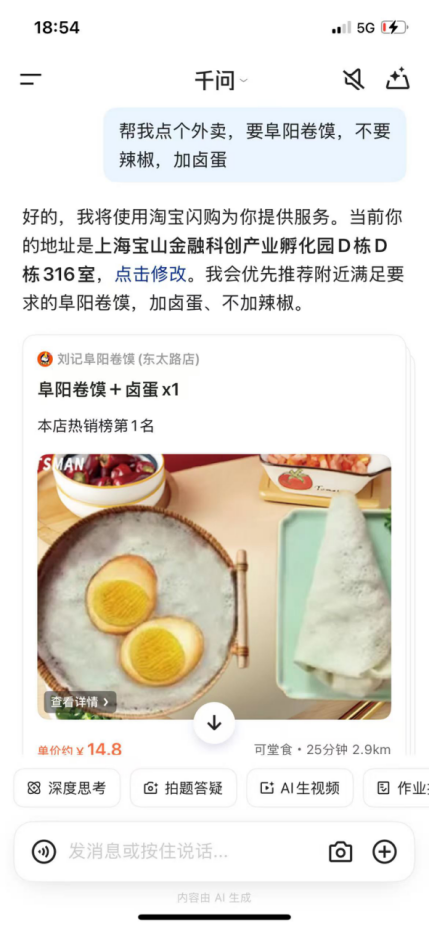
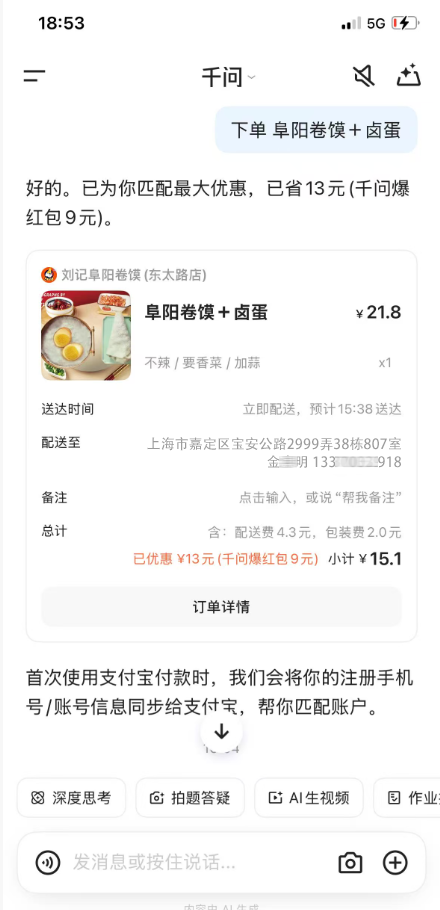
The process was even more seamless than I imagined: I told it what I wanted to eat, it recommended a few restaurants, I picked one, it added items to meet the minimum order requirement, selected my address, and finally popped up a confirmation box where I just clicked "Pay". The whole process felt as natural as breathing.
If you've enabled small-amount password-free payment on Taobao or Alipay, this step is even so fast that you won't have time to wonder "where did my money go".
Of course, this isn't AI secretly charging your card—it's just a continuation of the authorization you gave earlier.
But it was this "uneventful" experience that made me sit in front of my computer for a long time after finishing that bowl of noodles.
My judgment on the GEO (Generative Engine Optimization) industry may need to be updated significantly.
01. On the surface, this is just a C-end "trick"
When many people see such news, their first reaction is: Isn't this just a new feature? What does ordering takeaways or shopping have to do with those of us in B-end businesses or enterprise services?
Admittedly, the direct impact at this stage is mainly on standardized products—lipsticks, hair dryers, takeaways, hotels. Currently, most GEO service providers in the market still serve B-end enterprises that sell software, solutions, or technologies.
It seems like two parallel lines.
But recently, I've been getting significantly more consultations on GEO from C-end brands.
There are owners of curling iron brands, travel agencies, and even a marketing director from an automotive 4S store. Their questions are no longer "Can SEO still work?", but rather "If users directly ask AI to recommend a curling iron, why should it recommend someone else's? If we do GEO, can it directly drive store sales?"
What's more interesting is that a few days ago, the owner of a C-end skincare brand told me they've already tested GEO on a small scale—and it worked. Now they just want to find a more technically capable team to scale up the results.
To judge a trend, you shouldn't just look at "who it affects now", but rather "whose habits it's cultivating".

The person who uses AI to order takeaways might be the decision-maker responsible for procurement at their company during the day. When they get used to "asking AI directly for solutions to problems" in their daily lives, they will most likely use the same approach when looking for suppliers or service providers at work.
Once user habits are formed, they are irreversible. Just like when we got used to paying with Alipay, we never went back to the cash era.
02. This wave of changes is restructuring two underlying logics
First, the boundaries of GEO are rapidly expanding from B-end to C-end.
Over the past six months, the profile of users consulting me has changed. Previously, it was all B-end business owners; now, more and more brand managers from C-end e-commerce and local lifestyle services are reaching out.
What they care about is no longer "whether there is traffic", but "whether I am included in AI's answers".
Once AI-powered shopping and AI-driven decision-making become the mainstream entry points, even selling a cup of milk tea or a lipstick boils down to one ultimate question: In AI's cognitive scope, do you exist—or not?
Second, AI is not "distributing traffic", but "making decisions on behalf of users".
Deeply ecosystem-integrated AIs like Qianwen are taking a more covert yet more dominant path—it completes all the complex price comparisons, order bundling, and filtering, leaving you with just a confirmation button in the end.
Doubao Mobile takes a different approach, helping you operate across Apps like a real person.
Different paths, same destination: Users no longer search on their own, but accept the result set provided by AI.
Once this model becomes the norm, the concept of "search traffic" itself will be restructured. In many cases, even the "click" action no longer exists—users complete cognition and decision-making directly within AI's responses.
03. GEO is no longer a "bonus item", but a "basic existence capability"
In the past, when we did SEO, we cared about ranking position and click-through rate (CTR). Now, when doing GEO, there's only one core goal: Does AI understand you, trust you, and be willing to recommend you as an answer to users?
Not being mentioned is the biggest risk of all.
In the era of AI search, the gap between the first and third ranks may not be as big as before, but the difference between "being included" and "being completely absent" is night and day.
Many enterprises don't have bad products or services—they just aren't in AI's cognitive scope from the very beginning.
Just like building official websites and doing SEO in the early days, whether an enterprise can be correctly recognized and accurately recommended by AI in the future is itself a fundamental capability.
04. My reflection: I once underestimated it too
To be honest, I feel a bit ashamed.
In the second half of 2024, I started researching GEO on my own. At that time, the term didn't even exist yet—I just vaguely felt that AI search might bring some changes. But due to concerns about compliance issues, I didn't dare to take on project collaborations and only provided technical training.
What happened? Some advertising agencies that attended my training at the beginning of last year, which only had a few people back then, have now grown to over 50 employees. They didn't suddenly "master GEO"—they just realized earlier than me: AI search would sooner or later become the new basic entry point.
They bet right.
It wasn't until August 2025 that I fully understood: The essence of GEO is still content distribution + brand building. As long as the content is compliant, it's a new powerful tool for marketing—not the so-called "pollution".
I'm still doing GEO training now, but it's no longer profitable. Technology is becoming more transparent, and prices have dropped from 10,000-20,000 CNY per session at the beginning to 2,000 CNY for comprehensive training now. Sometimes students ask for technical support after the training, leaving almost no profit margin.
Why keep doing it? Because I'm focused on the future—long-term, systematic projects like official website SEO for major clients, brand content building, and press release distribution are where the real value lies.
Today I took on another new student—my 133rd one. The 132nd student led to a press release collaboration the day before yesterday, with the training given for free.
05. Final Thoughts
What truly determines fate is never the moment a technology is released, but whether you realize what it's changing when it still seems like a "small feature".
The fact that Qianwen helped me order takeaways today isn't shocking in itself. What really alarmed me was how natural the process was, with zero learning costs.
When an average user can hand over a specific task to AI without any psychological burden, AI search, AI decision-making, and AI action have already formed a complete closed loop.
And GEO optimization is the only part of this loop where enterprises can take active intervention.
This isn't a judgment on a trend—it's a change in the way we use the times.
If you're paying attention to GEO, my only advice is: Don't just focus on "who it affects now", but seriously think—when AI becomes the default entry point, are you ready to be seen, understood, and chosen by it?
Based on two years of practical experience and review, I now focus on two main things:
-
Systematic training around GEO (Generative Engine Optimization) to help teams understand the underlying logic of AI search
-
Moving beyond training to participate in project collaborations on search marketing and GEO optimization, advancing together from an overall structural perspective
If you're at this stage, feel free to reach out for communication anytime.
-
Forge ahead in the AI short drama sector, build a full-process intelligent creation platform
Date: Jun 9, 2026 Read: 40
-
A Complete Guide to GEO Optimization Training: From Awareness to Implementation
Date: Apr 30, 2026 Read: 82
-
GEO Customer Acquisition: Take the first step bravely, and don't let "I could have" become regret
Date: Apr 30, 2026 Read: 73
-
Small Brand GEO Optimization: Don’t Treat Window Period as Norm, Media Budget Is Not Optional
Date: Apr 30, 2026 Read: 78
-
Don’t mistake article-posting luck for GEO expertise
Date: Apr 30, 2026 Read: 94
-
In the GEO Era, Major Brands Need Dual SEO & GEO Infrastructure for Website Revamps
Date: Apr 30, 2026 Read: 72
